Engineering
8 min
ZPL converters do one thing. Label infrastructure does everything. Here is the difference between a viewer and a programmable pipeline engine for your warehouse labels.
zplflow team
Aug 11, 2026
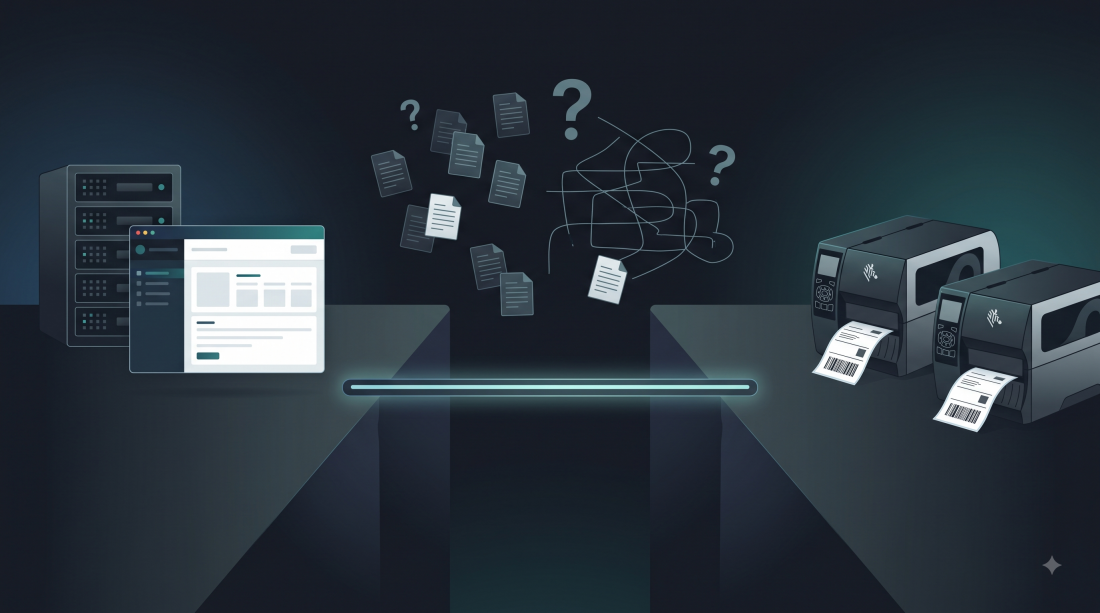
If you search for “ZPL tools” today, you will find a dozen converters. Most of them do one thing: they take ZPL code and show you a PDF preview. That is useful if you need to check what a label looks like. It is not useful if you need to run a warehouse.
The difference between a ZPL converter and label infrastructure is the same difference between a calculator and an accounting department. One gives you a number. The other runs your business.
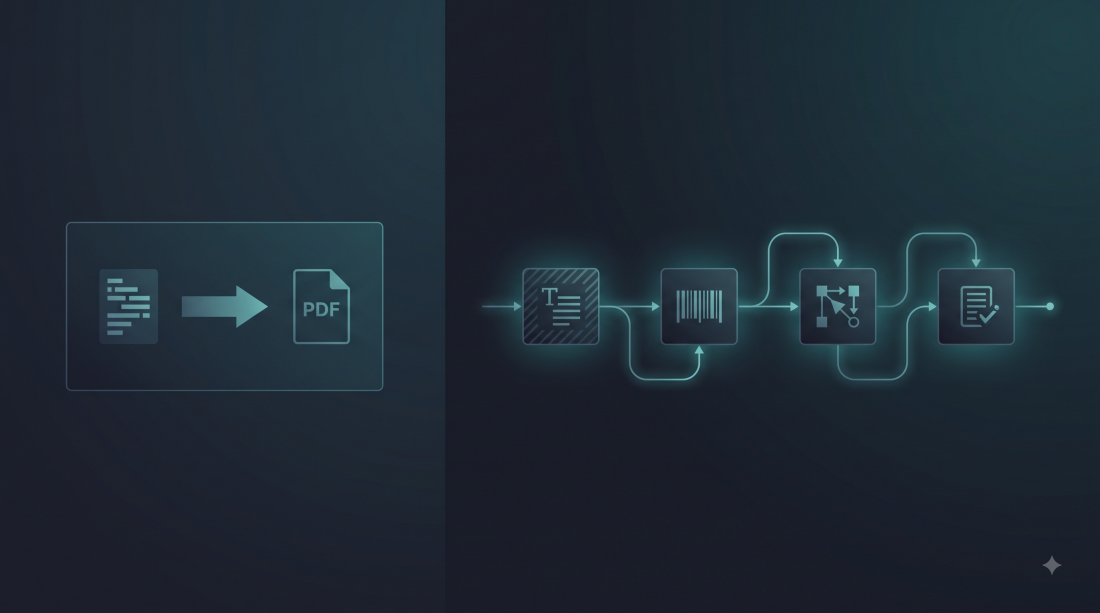
A converter takes input A and produces output B. ZPL goes in, PDF comes out. Or PDF goes in, ZPL comes out. It is a translation tool, and it stops there.
Here is what a converter cannot do:
These are not edge cases. These are daily operations in any 3PL or manufacturing warehouse that manages labels for multiple clients.
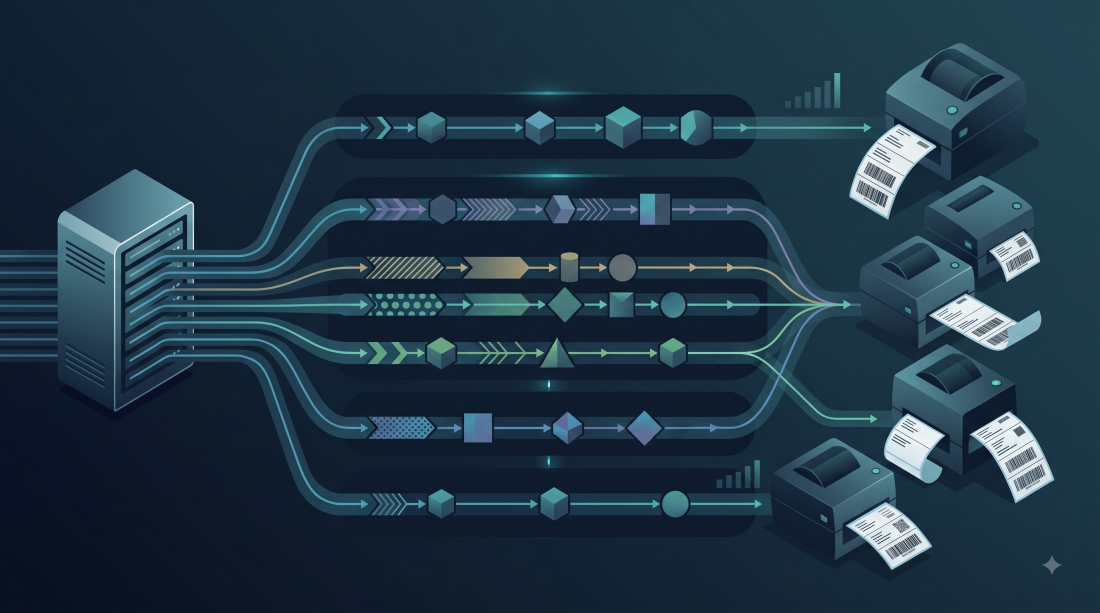
zplflow is not a converter. It is a programmable pipeline engine that happens to include conversion as one of its capabilities.
Here is the difference in practice.
Your client sends a ZPL template. You need to change the barcode value and add a timestamp. You open the ZPL in a text editor, find the barcode field, modify it manually, add a new field for the timestamp, test on one printer, test on another, fix alignment issues, deploy.
Time: 2 to 4 weeks. Cost: 2,000 to 5,000 euros. Risk: high.
You define a pipeline once. The pipeline is a sequence of transformations stored as JSON. Each transformation does one thing: replace text, add a barcode, insert a timestamp, rotate the label, apply GS1-128. You chain them together, save the pipeline, and forget about it.
From that moment on, every label that passes through the pipeline gets transformed automatically. Variables like {{tracking_number}} and {{client_name}} are resolved at runtime. The pipeline does not change. The data does.
{
  "name": "client-acme-shipping",
  "steps": [
    {"type": "replace_text", "search": "OLDBARCODE", "replace": "{{new_barcode}}"},
    {"type": "add_barcode", "barcode_type": "code128", "x": 100, "y": 200, "height": 50, "value": "{{tracking_number}}"},
    {"type": "add_timestamp", "x": 50, "y": 500, "font_height": 20, "format": "datetime", "timezone": "Europe/Berlin"},
    {"type": "add_gs1_128", "x": 50, "y": 400, "ai": [
      {"code": "01", "value": "{{gtin}}"},
      {"code": "17", "value": "{{expiry_date}}"}
    ]}
  ]
}
Time to apply: 2 seconds. Cost: 1 token per label. On the Growth plan, that is less than half a cent per label.
The pipeline engine includes 24 transformers organized in four categories:
Content manipulation (12 transformers): add text, barcodes, QR codes, DataMatrix, boxes, lines. Replace text, replace barcode values, remove graphics. Regex replacement. Timestamps and date formatting.
Geometric transformations (5 transformers): rotate, scale, add margin, crop, mirror. These change the physical layout of the label without breaking the print structure.
Print parameters (4 transformers): set font, set print darkness and speed, override label dimensions, set print quantity.
Logic and compliance (3 transformers): conditional logic (if/else on variables), GS1-128 with 50+ application identifiers, repeat for print copies.
The key insight: content manipulation steps are covered by a base quota of 1 token per pipeline execution. You can chain 10 text replacements, 3 barcode additions, and 2 GS1-128 insertions, and it still costs 1 token. Geometric transformations (rotate, scale, crop, mirror) and image embedding carry a small surcharge because they require a full render cycle.
This means a typical label transformation, the kind that used to be a 3,000-euro IT project, costs 1 to 3 tokens. That is 1 to 3 standard label conversions worth of tokens.
The converter vs. infrastructure distinction is not academic. It has real operational consequences.
With a converter, every label change is a project. You convert the format, then you modify it manually, then you test, then you deploy. Each change costs time and money. Your IT team spends their week editing ZPL text files instead of improving your core systems.
With infrastructure, every label change is a pipeline update. You modify one step in the JSON, save it, and every subsequent label gets the new transformation automatically. Your IT team does not touch ZPL files. Your operations team does not wait 3 weeks for a barcode change.
The math is simple:
| Converter (manual workflow) | Infrastructure (pipeline engine) | |
|---|---|---|
| Label change time | 2-4 weeks | 5 minutes |
| Label change cost | 2,000-5,000 euros | 1-3 tokens (< 0.01 euros) |
| Annual cost (10 changes) | 20,000-50,000 euros | 1,788 euros (Growth plan) |
| IT team time | 200+ hours/year | 5 hours/year |
| Error risk | High (manual editing) | Low (tested transformers) |
Most 3PLs start with a converter. Labelary is free, it shows you what the ZPL looks like, and it works for basic previewing. Then a client asks for a barcode change. Then another client asks for a GS1-128 field. Then a third client needs labels resized for a different printer model.
Each request pushes you further into manual ZPL editing. Each edit introduces risk. Each project costs more than the last because the templates get more complex.
The converter was fine when you had 3 clients and 10 labels. It breaks when you have 20 clients and 500 labels.
If you are evaluating label tools, here is the question that separates converters from infrastructure:
“Can I define a transformation once and apply it to every label automatically?”
If the answer is no, you have a converter. If the answer is yes, you have infrastructure.
zplflow gives you 24 transformers, deterministic pricing (you know the cost before you execute), and a pipeline engine that processes labels in seconds instead of weeks. The free tier includes 1,000 tokens per month, which is enough to test with your real templates.
Try zplflow free, no credit card required
zplflow is label infrastructure for 3PLs and manufacturing. Programmable pipeline engine, bidirectional PDF and ZPL conversion, deterministic token pricing. Integrate in minutes, not months.
Tag